

CGM Patches for Sensitive Skin: Dexcom G6 and G7 Options That Won't Irritate


What to look for in a patch for sensitive skin
Look for four things: a hypoallergenic adhesive, latex-free materials, a breathable backing, and a cut sized precisely to your sensor. None of that guarantees zero reaction, since no adhesive is universally safe for every person's skin, but it addresses the most common, avoidable causes of irritation. One thing worth knowing before you buy anything: if the reaction is coming from the sensor's own factory adhesive rather than an overpatch, a patch won't fix it, and it's worth reading the diagnostic section below before you spend money on the wrong product.
Two adhesives, two causes: patch adhesive versus the sensor's own
Every Dexcom sensor arrives with its own factory adhesive built into the housing. An overpatch, like the ones Type Strong makes, is a separate adhesive sheet applied over the top to reinforce that bond. These are two different products made from different materials, manufactured by different companies, and a reaction to one doesn't necessarily mean a reaction to the other.
This distinction matters more than it might seem, because most advice online, including a fair amount of what's been on this page before, talks about "the adhesive" as though there's only one to consider. In practice, the fix is completely different depending on which one is causing the problem. Switching overpatch brands does nothing if your skin is reacting to the sensor's own adhesive underneath, and no amount of skin prep changes the chemistry of a factory adhesive that genuinely doesn't agree with your skin. Getting this diagnosis right, before spending money on a second or third patch brand, is the single most useful thing this page can offer.

Allergic or just irritated? How to tell the difference
The two most common reactions look similar at a glance but come from different mechanisms.
Allergic contact dermatitis happens when your immune system identifies a specific chemical in the adhesive as a threat and mounts a response. It typically appears as redness, itching, and swelling that's often sharply outlined to the exact shape of the sensor or patch, sometimes with small blisters. It can worsen with repeated exposure to the same allergen, and it can develop even after months or years of using the same product without issue, since sensitization builds up over time.
Irritant contact dermatitis is not an immune response. It's skin damage from friction, trapped moisture, or a harsh substance breaking down the skin barrier directly. It tends to look like dry, chapped, or mildly inflamed skin roughly the shape of the device, and it usually improves once the source of friction or moisture is addressed, without the same tendency to worsen over repeated exposures. It's also, by far, the more common of the two: heat, sweat, and the constant low-level movement of daily life all wear down the skin barrier faster than a single brief contact would, which is why irritation often builds gradually over a wear cycle rather than appearing immediately.
If you're seeing a sharply defined, itchy reaction that's getting worse each time you apply a new sensor in the same spot, that pattern points toward allergy rather than simple irritation, and it's worth mentioning to your care team. One added complication: allergic sensitization can develop after months or years of trouble-free use of the exact same product, since the immune system's response builds up with repeated exposure rather than appearing from a first contact. A reaction that starts suddenly after a long stretch of using the same sensor without issue is not a sign the sensor changed; it's more often a sign your skin's relationship with the same chemical has.
Is it the patch adhesive or the sensor's own adhesive?
A simple test helps separate the two. If you've been reacting under a sensor that also has an overpatch on it, remove the overpatch on your next application and wear the sensor with just its own factory adhesive for one cycle. If the reaction still appears in the same spot, the sensor's own adhesive is the likely cause, and no overpatch, however hypoallergenic, will solve it. If the reaction is milder or absent without the overpatch, the overpatch material itself may be the trigger, and switching to a different hypoallergenic, latex-free patch is a reasonable next step. If you can't safely go without a patch because your sensor is prone to lifting, talk to your care team about a barrier wipe or film applied to clean skin before either adhesive goes on.
Isobornyl acrylate, a compound identified in the adhesive of several CGM systems, has been documented as a cause of allergic contact dermatitis in multiple published case series, including in FreeStyle Libre and OmniPod users, with researchers using patch testing and gas chromatography-mass spectrometry to confirm it as the specific trigger in affected patients. It's a useful example of why "hypoallergenic" claims deserve scrutiny: a compound can be present in a factory adhesive, identified by name in peer-reviewed literature, that no overpatch will neutralize, because the reaction is happening at the sensor's own adhesive layer, not at whatever sits on top of it. This is also why dermatologists sometimes recommend formal patch testing for anyone with a confirmed, worsening reaction: it identifies the specific allergen rather than leaving you to guess by trial and error across several patch brands.

What to look for: hypoallergenic, latex free, breathable, pre-cut
It's worth being direct about one thing: "hypoallergenic" has no legal or regulatory definition. Any manufacturer can put it on a label without meeting a specific standard. That doesn't make the term meaningless, but it does mean the honest way to evaluate a claim is to look past the word itself and check the material list.
Hypoallergenic adhesive should mean the formulation avoids the most commonly documented irritants and allergens in this category, including certain acrylates and colophony-based glues, but since there's no enforced standard, a manufacturer's own testing and transparency about materials matters more than the label. Ask, or look for, what a brand will actually tell you it excludes, rather than accepting the word on its own.
Latex-free materials matter even for people with a mild latex sensitivity, since repeated daily exposure over a wear cycle can provoke a reaction that a single brief contact wouldn't. Latex sensitivity can also develop gradually, the same way acrylate sensitization does, so a material that caused no issue a year ago isn't guaranteed to stay that way indefinitely.
Breathable backing lets heat and moisture escape from under the patch, which reduces the maceration and sweat buildup that commonly triggers irritant, rather than allergic, reactions. An occlusive, non-breathable backing traps both heat and moisture against skin that's already under adhesive stress, which compounds the problem rather than just adding a layer of protection.
A precision, pre-cut fit for your specific sensor model avoids the wrinkles and gaps that a generic or ill-fitting patch creates, which rub against skin and cause friction-based irritation independent of the adhesive's chemistry. A patch cut for the wrong device, even one made from otherwise skin-friendly material, can still cause irritation purely through poor fit.
Dexcom G6 vs G7 fit
Dexcom stopped manufacturing the G6 as of July 1, 2026, so this is now a legacy note for anyone still working through existing stock rather than an active choice for new prescriptions. Dexcom G7 and Dexcom ONE+ share the same compact, round housing and the same patch cut, so anything sized for a G7 also fits a ONE+.
|
Sensor |
Patch shape |
Why fit matters |
|
Dexcom G6 (legacy) |
Longer oval |
More surface area needs evenly distributed adhesive to avoid pressure points |
|
Dexcom G7 / Dexcom ONE+ |
Round and compact |
A smaller patch needs precise alignment, since there's less margin before an edge is exposed |
Using the wrong shape for either sensor increases the chance of creases and uneven pressure, both of which raise irritation risk independent of the adhesive material itself.
Type Strong's Dexcom patches for sensitive skin
Type Strong's Dexcom G7 / ONE+ patches and, for anyone still on existing stock, Dexcom G6 patches are made from a hypoallergenic, latex-free material with a breathable backing, cut specifically to each sensor's shape. They're designed to hold for 10 or more days, matching the sensor's own wear cycle, without needing the kind of aggressive adhesive that tends to cause more irritation on removal. We don't claim a specific published reaction rate, since we haven't run the kind of controlled clinical testing that would support one, and we'd rather say that plainly than imply proof we don't have.

How to prevent irritation before it starts
Even with the right patch, a few habits reduce risk regardless of which adhesive is involved:
-
Clean the skin thoroughly with an alcohol wipe to remove oils, sweat, and lotion residue before applying either adhesive. Residue left on the skin gives an adhesive a weaker, uneven surface to bond to, which increases the friction and micro-movement that causes irritant reactions.
-
Let the skin dry completely. Trapped moisture under an adhesive is one of the most common causes of irritant, rather than allergic, reactions, and it's also one of the easiest to prevent with a minute of patience before applying anything.
-
Rotate your sites. Repeated use of the same small area doesn't give skin time to recover between wear cycles, and cumulative micro-trauma to one spot makes that area progressively more reactive over time, even to a product that caused no issue elsewhere.
-
Trim body hair at the site to reduce pulling and micro-trauma on removal, which matters for both comfort and for reducing the small breaks in the skin barrier that can make irritation more likely.
-
Avoid doubling up patches. Layering multiple adhesives traps heat and increases friction rather than adding protection, and it can make it harder to tell which layer is actually causing a reaction if one develops.
-
Use a barrier wipe if you're prone to reactions. A barrier film creates a layer between skin and adhesive, which can reduce irritant contact dermatitis specifically, though it won't help with a true allergic response to a compound in the sensor's own adhesive, since the barrier sits on the skin side, not between the allergen and your immune system.
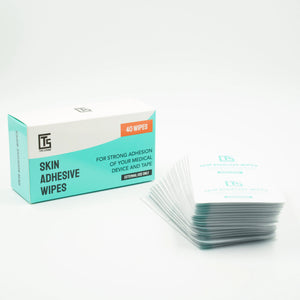
Our full guide on how to prep your skin for patches and skin adhesive wipes both support this routine.

Overpatch or underpatch, and what Type Strong does not make
Type Strong makes overpatches, which sit on top of the sensor to reinforce its own adhesive. We do not make an underpatch, which would sit between the sensor and your skin.
This is worth being precise about, because it isn't just a product gap. The UK's Medicines and Healthcare products Regulatory Agency issued a National Patient Safety Alert (DSI/2021/004, 6 April 2021) stating that use of barrier methods or patches is not recommended, as this may affect the performance of the device. That alert specifically concerns things placed under the sensor, between the device and the skin, since anything in that position can interfere with how the sensor reads glucose from interstitial fluid. An overpatch, which goes over the top of an already-applied sensor, is a different category and isn't what that alert addresses. If you're considering any product placed underneath a sensor rather than over it, that's a conversation to have with your care team first.
When to stop and see someone
Stop using a patch or sensor at a site and speak with a clinician if you notice blistering, oozing, spreading redness beyond the immediate application area, or a reaction that gets worse with each new application in the same spot. None of the guidance here is a diagnosis, and persistent or worsening skin reactions deserve a proper clinical assessment rather than another round of product-swapping.
A note on comfortable wear
Nobody should have to choose between keeping a sensor secure and keeping their skin comfortable. Getting the diagnosis right first, whether it's the sensor's own adhesive or an overpatch causing the problem, saves you from buying several products that were never going to help. Once you know which adhesive is actually responsible, choosing a genuinely hypoallergenic, latex-free, well-fitted patch and following a consistent skin prep routine solves the problem for most people the rest of the way.
People also ask
Why does a CGM patch irritate skin? Most reactions come from one of two causes: irritant contact dermatitis, from trapped moisture, friction, or repeated site use, and allergic contact dermatitis, from a specific chemical the immune system reacts to, such as isobornyl acrylate. Both can look similar at first glance but come from different mechanisms and need different responses.
Is it the patch adhesive or the sensor's own adhesive? Removing the overpatch for one wear cycle and watching whether the reaction persists is the simplest way to tell. If the reaction continues without the overpatch, the sensor's own factory adhesive is the more likely cause, and no overpatch will resolve it.
How do you tell an allergy from ordinary irritation? Allergic reactions tend to be sharply outlined to the device's shape, itchy, and often worsen with repeated exposure over time. Irritant reactions tend to look like general redness or chapping from friction or moisture and usually improve once that cause is addressed.
What does hypoallergenic actually mean? Legally, nothing specific. There's no regulatory definition or required testing standard behind the term, so it's worth looking at a manufacturer's actual material list, latex-free status, and any testing they can point to, rather than relying on the label alone.
Which Dexcom patches suit sensitive skin? A patch cut precisely for the G7 or ONE+ shape (or the G6 shape, for existing stock), made from a latex-free, breathable material, is the best starting point. Type Strong's Dexcom G7 / ONE+ patches and Dexcom G6 patches are both built this way.
Are Type Strong patches latex free? Yes. Type Strong's patches, including the Dexcom G7 / ONE+ and G6 ranges, use a latex-free, hypoallergenic material.
Does Type Strong make an underpatch? No. Type Strong makes overpatches only, applied over the sensor after it's in place. We don't make a product designed to sit between the sensor and your skin.
When should you stop and see a clinician? If you notice blistering, oozing, spreading redness, or a reaction that worsens with each new application at the same site, stop and seek a clinical assessment rather than continuing to try different products.
References
-
Medicines and Healthcare products Regulatory Agency (MHRA). National Patient Safety Alert DSI/2021/004, 6 April 2021.
-
Herman, A., Aerts, O., Baeck, M., et al. "Allergic contact dermatitis caused by isobornyl acrylate in FreeStyle Libre, a newly introduced glucose sensor." Contact Dermatitis, 2017;77(6):367-373.
-
Kamann, S., Aerts, O., Heinemann, L. "Further evidence of severe allergic contact dermatitis from isobornyl acrylate while using a continuous glucose monitoring system." Journal of Diabetes Science and Technology, 2018;12(3):630-633.
-
Heinemann, L., Kamann, S. "Adhesives used for diabetes medical devices: a neglected risk with serious consequences?" Journal of Diabetes Science and Technology, 2016;10(6):1211-1215.
-
Dexcom. "How much longer will Dexcom G6 be available?" dexcom.com
-
National Institutes of Health. "Protectors and adhesive removers for medical adhesive-related skin injury." pmc.ncbi.nlm.nih.gov/articles/PMC11080338


